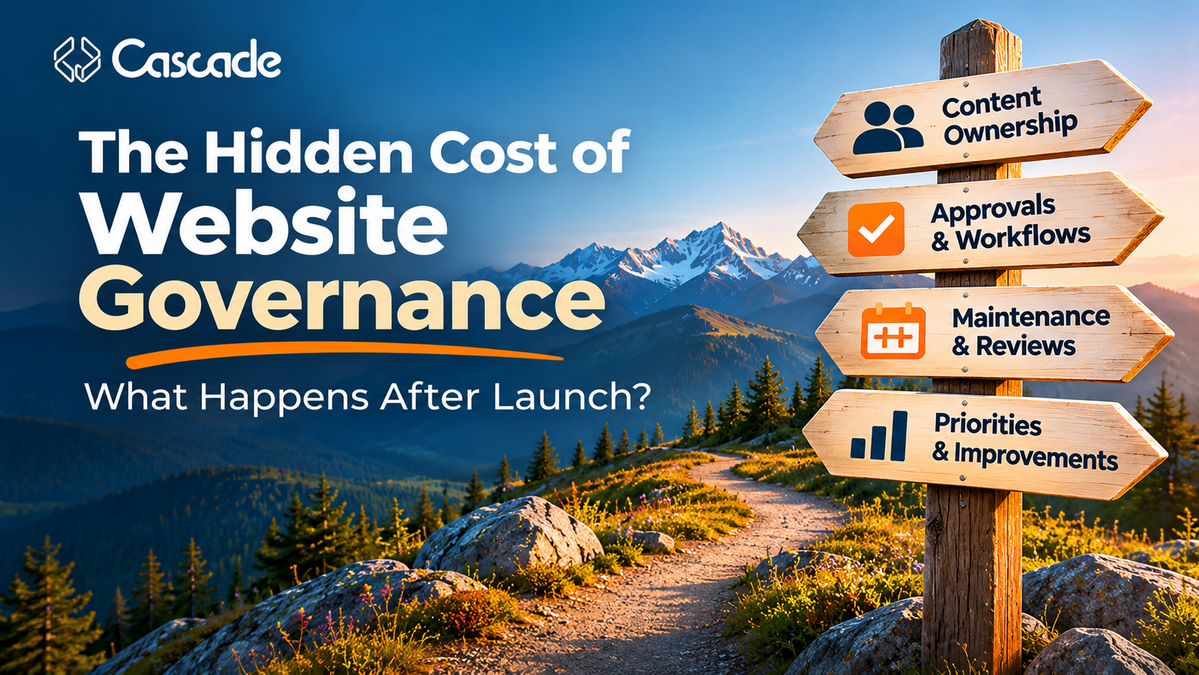
What is website governance?
I've worked on enough website projects to know that launching a new site is often the easy part. Keeping it organized, accurate, and useful over the next several years can be a much bigger challenge. Not necessarily because the technology is difficult to maintain, but because of everything happening around it.
This is something I've been thinking about quite a bit lately, especially as we work through website strategy, content planning, and CMS requirements with clients at Cascade. We spend a lot of time helping organizations figure out what their websites need to do, but there's another question that's just as important: how will they manage everything once the website launches?
The technology is certainly part of the equation, but it's rarely the whole story. Sometimes the biggest challenges have less to do with how a website was built and more to do with how an organization manages it.
Website governance is the set of responsibilities, processes, permissions, and standards that determine how an organization manages its website over time. It establishes who owns the content, who can make changes, how those changes are approved, and how the website is maintained as the organization evolves.
That includes more than publishing blog posts or managing CMS users. It also involves content quality, accessibility, technical maintenance, organizational priorities, and the decisions that determine how the website grows.
Think about a larger organization where marketing manages the website, IT oversees infrastructure, individual departments provide content, and leadership reviews important messaging. All of those groups have legitimate responsibilities, but what happens when their responsibilities overlap or nobody is quite sure who has the final say?
Someone needs a page updated, but they're not sure who to contact. A department changes a service, but related content elsewhere on the website doesn't get updated. Marketing wants to publish something, but the approval process involves several people who may not even need to be part of the decision.
None of these situations necessarily means the website is broken. But they can make it much more difficult to manage than it should be.
Where the hidden costs start adding up
When we talk with organizations about website maintenance, the conversation usually begins with the more obvious expenses: hosting, support, software, security, development, and ongoing improvements.
What doesn't always get accounted for is the amount of staff time spent coordinating relatively simple work.
Imagine a marketing team needs to update the description of a service. They send a request to the department responsible for that service, wait for revised copy, forward it for approval, and then submit another request to whoever manages the website. A few days later, someone finally makes the change.
The actual update might take 15 minutes. Getting to that point could take several days.
It's easy to dismiss that as normal business activity, but those little inefficiencies can add up across dozens of departments and hundreds of pages.
Research from Content Marketing Institute helps put some context around the problem. Its Enterprise Content Marketing Research 2025 found that 61% of enterprise marketers reported challenges communicating across organizational silos, while 47% identified workflow or content approval processes as a challenge.
Those figures represent enterprise content marketing operations broadly, not website governance specifically. Still, they reflect the same kinds of organizational challenges that can make website management unnecessarily difficult.
The cost isn't just the time spent processing requests. It's also the work that doesn't get done because people are busy managing the process.
What we've learned about website governance at Cascade
At Cascade, our website projects typically begin with strategy and planning. Before we start designing pages or developing functionality, we want to understand what the organization needs the website to accomplish and how people will actually use it.
That includes the visitors, of course, but it also includes the people responsible for managing the website.
We've found that questions about administration can reveal important requirements that aren't obvious when you're only looking at the public-facing experience.
For example, a client might tell us they want their marketing team to have more control over the website. That's a reasonable goal, but what does that actually mean?
Do they want to edit existing page content? Create new landing pages? Manage navigation? Publish resources? Update employee profiles? Change reusable content that appears across multiple sections?
Those are different responsibilities, and they don't necessarily require the same level of access or oversight.
One of the advantages of working with a CMS that can be configured around an organization's needs is that we can think carefully about those distinctions. In Cascade's Evergreen CMS, for example, we can structure content around specific types of information and build administrative experiences that support how the organization works.
But the technology still needs direction.
A CMS can provide editing tools and permissions. It can't determine which department should be responsible for keeping a service description accurate or whether a particular change needs executive approval.
Those decisions need to come from the organization, ideally with some guidance during the planning process.
Content structure can make governance easier or harder
One area where governance and technology really come together is content architecture.
Let's say an organization has staff profiles appearing throughout its website. A person's name, title, photograph, and biography might appear on a team page, within a service section, and alongside related projects.
If that information is manually entered in several places, updating it becomes a bigger task than it needs to be. Someone has to know everywhere the information appears and remember to update each location.
A more structured approach allows that information to be managed centrally and reused where appropriate.
We think about this quite a bit when planning CMS functionality. The goal isn't simply to make content editable. It's to make content manageable.
The same principle applies to services, locations, projects, frequently asked questions, and other information that may appear in multiple places.
Better content architecture can reduce duplication and make updates easier, but it also creates a clearer picture of who should be responsible for maintaining each type of information.
More editing flexibility isn't always better
Another lesson we've learned is that giving people complete control over every part of a website isn't necessarily helpful.
Most content editors don't want to make decisions about page layouts, spacing, typography, or component behavior every time they publish something. They want to add or update information without worrying about accidentally breaking the design.
That's why we often recommend structured content fields and reusable templates instead of treating every page like a blank canvas.
It creates consistency for visitors and makes routine administration more predictable.
Of course, some organizations genuinely need flexible page-building tools, particularly for marketing campaigns or frequently changing landing pages. The important thing is understanding where flexibility adds value and where it introduces unnecessary complexity.
Those decisions should be part of website strategy, not something everyone has to figure out after launch.
Who should own website content?
One question I like to ask during website planning is who will be responsible for the content once the new site launches.
Not just who will write it initially, but who will make sure it's still accurate six months or two years later.
Content ownership means assigning accountability for the accuracy, relevance, and ongoing maintenance of information on the website. The owner doesn't necessarily need to write or publish every update, but someone should know they're responsible for that information.
A service page is a good example. Marketing might be responsible for how the page is written and presented, while the department providing the service is responsible for confirming that the information is accurate.
Both responsibilities matter.
Without that distinction, it's easy for content to become outdated. A service changes, but nobody updates the website because everyone assumes someone else is handling it.
We generally recommend identifying content owners at the section or content-type level rather than creating an overly complicated system for every individual page.
The approach needs to be practical enough that people will actually follow it.
How should website approvals work?
Approvals are important, but not every website change carries the same level of risk.
Correcting a typo shouldn't require the same process as publishing a new service offering. Updating an employee photograph shouldn't necessarily involve the same stakeholders as changing the organization's primary messaging.
A useful approach is to establish different levels of review based on the type of change being made.
Routine edits can often be handled by trained content editors. New or substantially revised service content may need review from a subject matter expert. Legal, regulatory, or sensitive information may require additional approval.
The CMS should support those responsibilities where appropriate, but the workflow doesn't always need to be complicated or automated.
Sometimes a clearly documented process and the right permissions are enough.
The goal is to protect content quality without creating unnecessary delays.
What should a website governance plan include?
A website governance plan doesn't need to be a lengthy document. For many organizations, a relatively simple framework is enough to establish responsibilities and reduce confusion.
We recommend starting with five areas:
- Content ownership: Identify who is accountable for the accuracy and maintenance of each major section or content type. Marketing may manage publishing while individual departments remain responsible for verifying their information.
- Roles and permissions: Define what different users should be able to edit, create, approve, and publish. Permissions should reflect actual responsibilities rather than giving everyone the same level of access.
- Publishing and approvals: Establish which changes can be made directly and which require additional review. Keep routine updates simple while providing appropriate oversight for higher-risk content.
- Content maintenance: Set reasonable expectations for reviewing important pages, updating outdated information, and removing content that is no longer useful.
- Prioritization and accountability: Establish how website requests are submitted, evaluated, and prioritized, including who makes decisions when requests compete for limited time or resources.
These five areas provide a useful starting point, but the details should reflect the organization. A small business with one marketing manager doesn't need the same governance structure as a university, healthcare organization, or government agency with dozens of contributors.
A practical example of website governance responsibilities
| Responsibility | Typical Owner | Supporting Roles |
|---|---|---|
| Website strategy and priorities | Marketing or digital leadership | Department leaders, agency |
| Accuracy of service information | Department or subject matter expert | Marketing |
| Editing and publishing | Content editor or marketing team | Department reviewers |
| Brand and design consistency | Marketing or creative lead | Agency |
| Hosting, security, and technical maintenance | IT or development partner | Website administrator |
| Accessibility and quality assurance | Shared organizational responsibility | Design, content, and development teams |
| Content review and retirement | Assigned content owner | Marketing or website administrator |
These are examples rather than universal assignments. The important thing is that the organization knows who is accountable for each responsibility.
Why website governance matters for SEO and AI Search
There's another reason this conversation is becoming more important: the way people discover information is changing.
Search engines and AI-powered tools increasingly help people answer specific questions without requiring them to begin on a company's homepage. Someone researching an organization's services, policies, locations, or expertise may encounter an individual page directly through Google Search, an AI Overview, ChatGPT, or another discovery platform.
That means the accuracy and usefulness of individual pages matter.
If a service page is outdated, the problem isn't limited to someone browsing the website. The information may also be discovered through search or used by an AI system attempting to answer a related question.
Good website governance helps organizations maintain information that is accurate, consistent, and useful wherever people encounter it.
It also creates a process for keeping content aligned with the organization's current services and expertise. That includes reviewing older articles, maintaining important FAQs, updating staff and location information, and making sure related pages don't contradict one another.
Google's guidance for its AI search experiences continues to emphasize helpful, reliable, original content and the technical foundations that allow pages to be discovered and indexed.
Governance doesn't guarantee that a website will appear in an AI-generated answer, but it supports the content quality and maintenance practices that make a website a more dependable source of information.
For organizations investing in SEO or AI Visibility, I'd consider content governance an important part of the long-term strategy rather than a separate administrative concern.
How to evaluate your current website governance
If you're wondering whether your organization has a governance problem, I'd start by talking to the people who manage the website every day.
Ask them to walk through the last few content updates they completed. Who requested the changes? Who provided the information? Did anyone need to approve it? How long did it take, and where did the process slow down?
Then look at how the website itself supports those tasks.
Are people copying the same information into multiple places? Do content editors have the permissions they need? Are routine updates dependent on a developer? Can the team easily identify outdated content? Is there a clear way to request and prioritize larger improvements?
You may discover that the technology is creating unnecessary work. Or you may find that the existing tools are capable, but nobody has established a consistent process for using them.
Content Marketing Institute's 2025 enterprise research found that 38% of respondents reported having content management technology they weren't using to its full potential. That's a useful reminder that replacing a platform isn't always the first or best solution.
Sometimes better training, clearer responsibilities, or a few thoughtful CMS improvements can make a meaningful difference.
When is it time to revisit your CMS?
There are situations where governance challenges do point to technology limitations.
If routine updates consistently require development assistance, if the CMS can't support appropriate user permissions, or if content needs to be maintained in several places because the platform lacks reusable structures, it may be worth evaluating whether the system still meets the organization's needs.
But I'd want to understand those limitations before recommending a replacement.
A CMS migration is a significant investment. Moving to a different platform without addressing the underlying governance issues can leave an organization dealing with many of the same frustrations in a new system.
That's why we believe website strategy should consider the administrative experience alongside design, development, and the public-facing user experience.
A better website starts with a better process
A website can be beautifully designed, technically sound, and built on a capable CMS, yet still be difficult and expensive to maintain.
Over time, those challenges affect more than the people managing the website. Outdated information, inconsistent content, delayed improvements, and unnecessary dependencies can all affect the experience visitors have with the organization.
Before investing in another redesign or platform replacement, it's worth asking a fairly simple question:
What takes more time or effort than it should when our team is trying to update the website?
The answer can reveal opportunities that aren't obvious from looking at the website itself.
At Cascade Web Development, we help organizations work through these questions as part of website strategy, planning, design, and ongoing support. We look at the technology, but we also look at the people and processes behind it, because all three contribute to how well a website works over time.
If your website has become harder to manage than it should be, let's talk about where the challenges are coming from.
And now that I've spent this much time thinking and writing about website governance, maybe I should share a few of these thoughts on LinkedIn, too. Apparently, I have opinions on the subject.